


The Secret Weapon that could Triple your Win Rate
Do you have a great product and the capacity to deliver exactly what the procurement authority has asked for? Even with a great capture team, do you still struggle to win competitive contracts? Does the bid start well but descend into chaos at the first quality review (Pink Team or equivalent)? Do you have a bid manager with the experience to help you win bids?
A client recently told me that their company’s win rate can be as low as 20%, but when they bring in external support, it rises to around 60%. This is partly due to external support not being as distracted as the in-house team who have to juggle multiple projects at the same time. But the main reason for this is that we deploy a secret weapon to lead our team – a chief of staff.
I was recently asked if I could provide a client with a bid manager for a series of forthcoming tenders. I proposed a senior member of my team with many years of experience in bid work and a master of their field. Then I sat back waiting for the purchase order. It was a surprise when they came back to me asking for someone less experienced.
Why would they want that? In an adversarial process like bidding, where quality is everything and there is only one winner, who wants to reduce their chance of coming first? Why would they choose someone less experienced – accepting that less experienced = less expensive?
I concluded that they didn’t expect the bid manager to have significant involvement in the quality of the bids. Rather, they wanted someone to make sure everything was completed on time, in the right format, and submitted on the right day. They would ensure that the fonts, margins, and so on are as requested and that the sections produced mirror the book plan. They may also manage the conduct of quality reviews and chase up late work from writers.
My client didn’t need someone who was going to get into whether the bid was compelling or even compliant. What he was after was what Salentis calls a proposal coordinator.
I have seen few in-house bid managers take an active role in considering whether the questions asked by the authority have been answered. Or to consider whether those answers are compelling and focused on making the decision easier for the evaluator. Few also fix any of these things when they have drifted. I apologise now to those out there that do; I’m just not seeing them. They typically do not have the experience, and sometimes lack the authority, to do so.
So, who is the person who is wholly focused on the quality of the proposal? Who manages its development and production?
Is it the capture manager?
Many of the in-house bid teams I see have a great senior capture executive; experienced, motivated, dynamic, and hands-on. Often, the issue of compliance falls to them. They typically plan the bid schedule, assign writers to sections, address pricing and other commercial considerations, and give direction following quality reviews. The quality of the bid is in their hands. But they are also likely to be maintaining the relationship with their customers and subcontractors, and keeping their eyes on other pursuits. They will be navigating the bid through their corporate gates and possibly delivering other live contracts. They may have time to work on the bid for a few hours a day. Unfortunately, other distractions mean that they aren’t able to be fully engaged in ensuring the bid documents are as good or as effective as they need to be to secure a win.
Instead, what we often see is the capture manager launching their nominated writers at their sections following a short kick-off. They rarely have any idea how the writers are approaching their task, or whether they are on schedule between milestones which are often weeks apart. The capture manager then finds him/herself deeply disappointed by the proposal.
Writers have acted unilaterally in the absence of proper direction and control or have left it to the very last minute. This has a predictable impact on quality. We also see occasional no-shows at Pink Team, with a variety of excuses. Cue much emotion, re-writes, and second Pink Team reviews that are both a waste of resources and knock the proposal schedule completely off-track. The proposal will probably never recover, though working weekends and nights, it may be possible to submit a ‘best effort’. But it probably won’t win.
It really doesn’t have to be this way.
So, it’s not the capture manager.
If not the capture manager, then who?
We are still missing someone who can drive excellence into the proposal. Someone who is wholly focused on the quality of the content and who manages its development and production from kick-off to submission.
To understand who this should be, I look back at my experience of 30+ years in the military. I’ve seen this kind of team many times, well before I had even heard of bids and proposals. This experience makes it clear to me who is missing.
Military roles explained
Military units and headquarters all have the equivalent of the capture executive. This is the commanding officer or CO, and the two roles match closely. The CO has overall responsibility for the unit. They give direction and intent based on their professional skill and experience to achieve what they have been ordered to do. But whether in combat or in barracks, they are as focused on what is happening in their higher-level organisation, and what their neighbouring units are doing, as they are on their own. Detailed plans are not developed or enacted by the CO. They pass on to their support team their vision for the intended approach, stipulate any non-negotiables that may be necessary. These are kept to as few as necessary. Then they trust their team to get on with it.
Military units also have the equivalent of the bid manager described previously. The Regimental Sergeant Major, or RSM, is adept at making sure that everything turns up on time where it needs to be and with the right equipment. They are also the CO’s eyes and ears for HR issues and a lot more besides. Theirs is an absolutely essential role but, in broad terms, they are ‘making the arrangements’; fully empowered to make things happen. But they aren’t generally involved when it comes to deciding what happens.
In terms of a bid team, the RSM role maps more closely to a proposal coordinator than a bid manager.
You need the equivalent of a chief of staff as your bid manager
The secret weapon in any unit is its second in command and their equivalent in a military headquarters, the chief of staff (COS). The COS is the senior team member who makes the detailed plan to implement the direction given by the CO. They make sure their intent on the approach to achieving the stated goal is transformed into reality. The COS gets right into the detail of the planning once the CO has endorsed the plan. It is the COS who ensures the plan is followed. Where things start to go awry, as they inevitably do, the COS is responsible for bringing it all back on course.
The role of the chief of staff
It is the COS who will think ahead to what is most likely to go wrong and prevent it or anticipate what to do if it does. In fact, it is the COS that does the hardest work in the leadership team. They hone in on the detail the CO cannot possibly have the time to get into and likely never knows about. Importantly, the COS is empowered to make most decisions. They will check back with the CO regularly, especially when they feel they are approaching the boundaries of their authority. When success comes, it is the CO and RSM who often get the plaudits and medals. But most military commanders accept it is their COS who is the unsung hero of the day. The best ones rise quickly to become a CO in their turn.
The COS rarely does it all on their own. They typically have a team of talented people to help them do all that planning and running of operations. But this team is managed in great detail by the COS, and it is the COS with whom the buck stops.
This is based on my experience in the British Army and working closely with the Royal Marines. But the Navy also follows a similar model. The ship’s Executive Officer (XO) does the essential, detailed running of the ship on behalf of the captain.
The Salentis proposal manager as chief of staff
We in Salentis think that every capture executive should have a COS. Within our bid teams, this role is the proposal manager. If it is too much of a stretch to invent a new position called Proposal Chief of Staff (although P-COS does have a certain ring to it) then call them proposal director. Or think of some other neat title. But the selected individual needs to have the skill and experience, and access to the right tools, to plan and deliver a proposal with sufficient authority. The writers will follow their advice and direction on making their sections compliant, compelling, and timely.
Writers not used to being held to account or being required to justify their approach at all stages of development, or having to play their part in achieving consistency across all the sections of the bid, will hate the idea of this. This may tell you everything you need to know about how essential it is.
The different roles defined
In the table below we define what we believe proposal roles are in a bid against their equivalents in the armed forces:
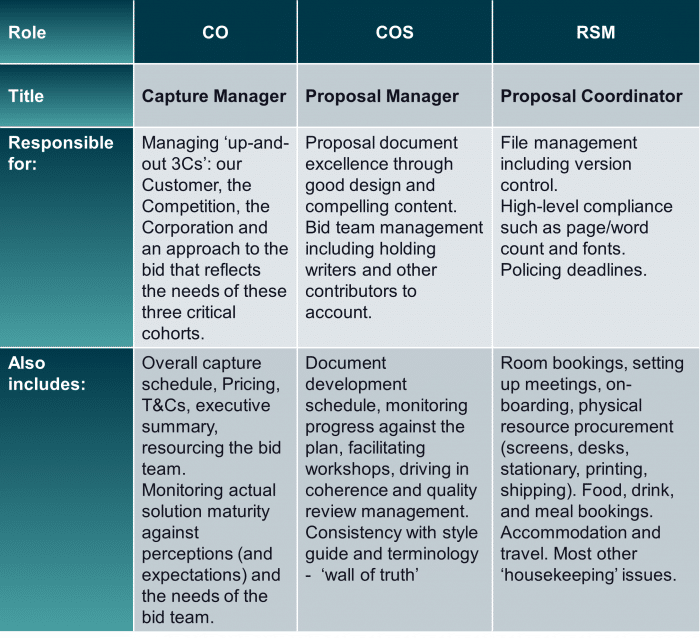
Bid teams still need the equivalent of the RSM figure. Whether they hold the title of proposal/bid manager or proposal/bid coordinator within your organisation isn’t important. Working with the COS they can be the strongest of teams. Covering all angles between them, thinking ahead, and seeing off problems before they arise.
It should be clear by now that a chief of staff is a senior role. Appointing one will require an investment by the bidder. Whether you develop your own chiefs of staff or ask to use one of ours as part of a curated Salentis bid team to support your capture managers, the investment will be repaid many times over.
Our experience is that doing so will make a significant improvement to bid quality across the board. They will become an indispensable part of the company’s bid and capture team. But if your competitors do it, and you don’t, then you could be in trouble. That’s the problem with secret weapons; they work best when you have them, and your competitors don’t. So, let’s keep this to ourselves, shall we?
Author – Richard Haldenby
Article published: January 2022
Back to Articles Page